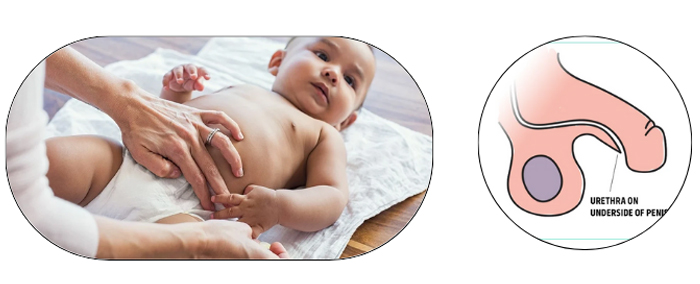
Hypospadias is a congenital condition in boys where the opening of the urethra (urine passage) is located on the underside of the penis rather than at the tip. It is one of the most common congenital penile abnormalities, occurring in about 1 in every 200–300 male births. The condition arises during fetal development when the urethral tube and penile foreskin do not form completely. The exact cause is not fully understood but is believed to involve genetic, hormonal, and environmental factors.
Hypospadias can vary in severity depending on how far the opening is from the normal position. It may be located near the head of the penis (distal), along the shaft (midshaft), or near the scrotum (proximal). In addition to abnormal opening, boys with hypospadias may have a downward curvature of the penis (chordee), abnormal urinary stream, or an incomplete foreskin that appears like a “hood” on top.
Diagnosis is generally made at birth during routine examination. Parents may notice abnormal urine spraying, difficulty directing urine, or unusual appearance of the penis. Hypospadias should not be corrected by circumcision at birth because the foreskin may be required for surgical repair.
The main treatment for hypospadias is surgical correction, typically performed between 6 and 18 months of age, when healing is optimal and psychological impact is minimal. Surgery involves repositioning the urethral opening, straightening the penis if necessary, and reconstructing the foreskin or performing circumcision based on the parents’ preference. Advances in pediatric urology have made hypospadias repair highly successful, with most children achieving normal urinary and reproductive functions.
Untreated hypospadias can lead to difficulties such as abnormal urination, sexual dysfunction in adulthood, or psychological concerns due to appearance. However, with modern techniques, complications like fistula, narrowing of the new opening, or scarring occur in a small percentage of cases and can often be corrected with a minor procedure.
Post-surgery, most children recover well with proper care, including catheter management, medication, and hygiene instructions. Regular follow-up ensures that the urinary function and cosmetic outcomes remain optimal.
With early diagnosis and expert surgical care, hypospadias is a highly treatable condition, allowing children to grow normally with proper urinary control and normal penile function.